From a request to a decision — and the work that follows it.
Qarar+ runs the full decision cycle: request, recommendation, approval, decision, and the tasks it creates — with AI that runs inside your own servers and draws on your institution’s own memory.
Request to closure in one platformSeven local AI enginesCited answers from your decisionsApprovals that escalate themselvesTasks updated from emailArabic and EnglishHijri and Gregorian
Decision journeyin approval
Recommendation
Approval
Decision
Ask the institution’s memory
Decisions issued on flexible and remote work
Sources: 2026/0005 · 2026/0035
7AI engines, all running on your own servers
6Stages from request to closure
4Confidentiality levels, with clearance per person
0Bytes that leave your network
The problem
Where decision-making breaks down — and how Qarar+ fixes it
Most entities decide well and remember badly. The reasoning behind a decision lives in one person’s head, approvals circulate on paper, and the work a decision creates is chased by phone. Here is what changes.
Today
Decisions nobody can trace
The same subject is debated again because no one can find what was decided before, or why.
With Qarar+
Institutional memory, one question away
Ask in Arabic and get a written answer citing the entity’s own decisions, each one openable.
Today
Preparation takes days
An analyst starts from a blank page, hunts for precedents and drafts the recommendation by hand.
With Qarar+
A cited draft in minutes
Qarar+ suggests the classification and department, warns of duplicates, surfaces precedents and drafts a recommendation with numbered sources.
Today
Approvals circulate on paper
Files move between offices with no record of who held them, for how long, or why.
With Qarar+
A chain that records and escalates itself
The authority matrix picks the route by classification and value; every step is timestamped, and delays escalate automatically.
Today
A decision ends at the signature
Clauses are typed into a spreadsheet, if at all, and ownership is never settled.
With Qarar+
Clauses become owned, dated work
Each clause becomes a task with an owner, due date and priority — proposed from the entity’s own past work and confirmed by a person.
Today
Follow-up by phone call
Managers learn a task is late only after it is late, and closure rests on someone’s word.
With Qarar+
Closure on evidence, warnings before the date
Tasks close on delivered evidence, and Qarar+ flags the ones likely to finish late, with the reasons.
Today
Double data entry
Staff report progress by email, then someone is expected to retype it into the system.
With Qarar+
The email is the update
Local AI reads the reply, extracts the progress, applies the clear ones and holds the sensitive ones for a person.
The journey
One request. One controlled path.
Every request travels the same six stages. Each has an owner, a status and a next step — and every action is recorded with who did it and when.
01
Request
AnalystClassification suggested
The subject and its justification are registered; Qarar+ suggests the classification and department and warns of duplicates.
02
Recommendation
AnalystPrecedents reviewed
Precedents are surfaced and a cited draft is prepared, then edited by the analyst and submitted.
03
Approval
ReviewersAwaiting review
The route comes from the authority matrix. Each reviewer sees the file, the precedents and the chain; delay escalates.
04
Decision
Authorised signatoryIssued and locked
The decision is issued with its clauses, numbered and closed to further editing.
05
Tasks
OwnersIn execution
Clauses become tasks with owners, due dates and priorities; progress is carried by evidence.
06
Closure
AssignerClosed on evidence
Work closes against delivered evidence, and the decision joins the institutional memory.
In-house AI
Seven AI engines — every one of them inside your servers
The AI in Qarar+ runs entirely on the entity’s own servers, on the central processor, with no external service — so no document, request or message ever leaves. Each engine shows its confidence and its sources, and its live figures are read straight from the records.
7AI engines, every one of them local
0External services called
2Languages understood — Arabic and English
100%Of the processing inside your own network
The engines
Seven engines — and where each one appears
Optical character recognition (OCR)
Neural models read documents scanned in Arabic and English, with a second pass over Arabic to correct digits and words, and extract the decision’s number, date and subject for an employee to confirm.
Appears in: Archive import, and adding a document to knowledge
Search and answering questions
An Arabic search engine that understands word forms — the definite article, prefixes and suffixes, and broken plurals — ranks results by relevance and answers in writing, citing a source for each statement, within the asker’s own permissions.
Appears in: Institutional knowledge, and suggested questions on the home page
Precedent matching
Matches every new request to the decisions and archived documents most like it, warns of open requests on the same subject, and measures how many of its precedents analysts judge relevant.
Appears in: Register a request › review precedents
Suggesting classification, department and owner
A nearest-neighbour model proposes the classification and department for a request, and the owner, due date and priority for each decision clause, drawn from the nearest past decisions and tasks, with a confidence score and a reason.
Appears in: Register a request, and create tasks from clauses
Drafting the recommendation
A first draft is prepared in seconds from the request’s own data and its precedents, with every paragraph referred back to its source, for the analyst to review and edit before use.
Appears in: Request page › draft with AI
Understanding email replies
Reads staff replies to task emails and extracts progress, completion, delay and new dates with a confidence score. Clear updates apply automatically and can be undone; sensitive ones wait for a person to confirm.
Appears in: Tasks › email updates
Estimating the risk of delay
Estimates the chance each open task finishes late from progress against time elapsed, the owner’s record of meeting deadlines, and changes to the due date — and shows the reasons for every task it flags.
Appears in: Tasks › likely to be late
The guarantees
What the AI will not do
Data sovereignty
The engines run on the entity’s servers, with no graphics processor and no cloud model.
No invented answers
Every result is drawn from the entity’s own records, with its source and its confidence.
Accuracy you can measure
Accuracy is measured against the entity’s latest real decisions, and every AI action is written to the audit trail.
The decision stays human
No sensitive change is applied without a person confirming it.
Next phase — Qarar AI. A large Arabic language model, hosted locally on the entity’s own servers, for richer drafting and summarising — again without data leaving those servers.
The product
Real Qarar+ screens
The working interface, shown with demonstration data — in Arabic, with Hijri and Gregorian dates throughout.
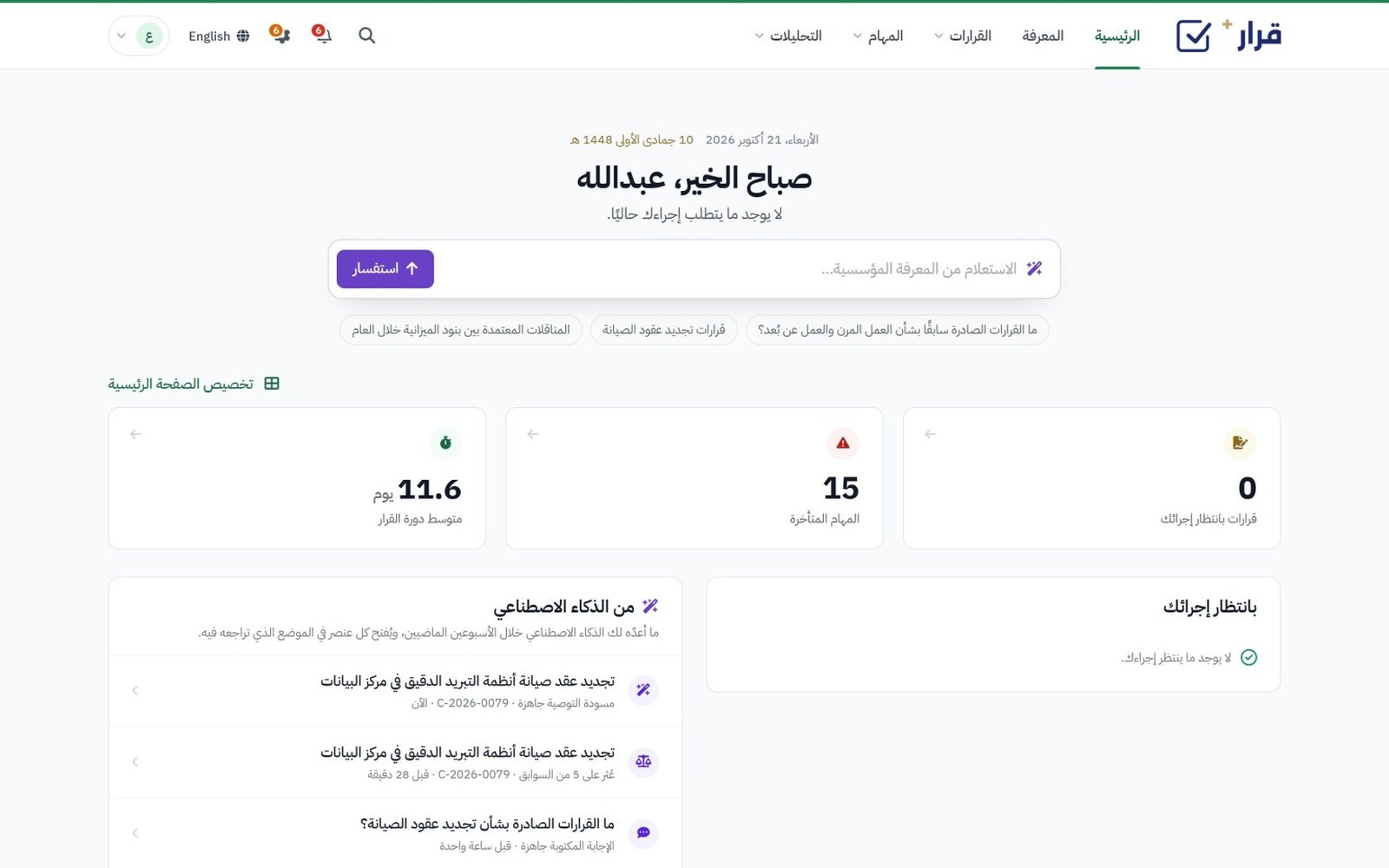
One screen for what needs your decision
Each role opens on its own home: what waits on them, what is late, where cases are stuck — and what the AI has prepared since yesterday.
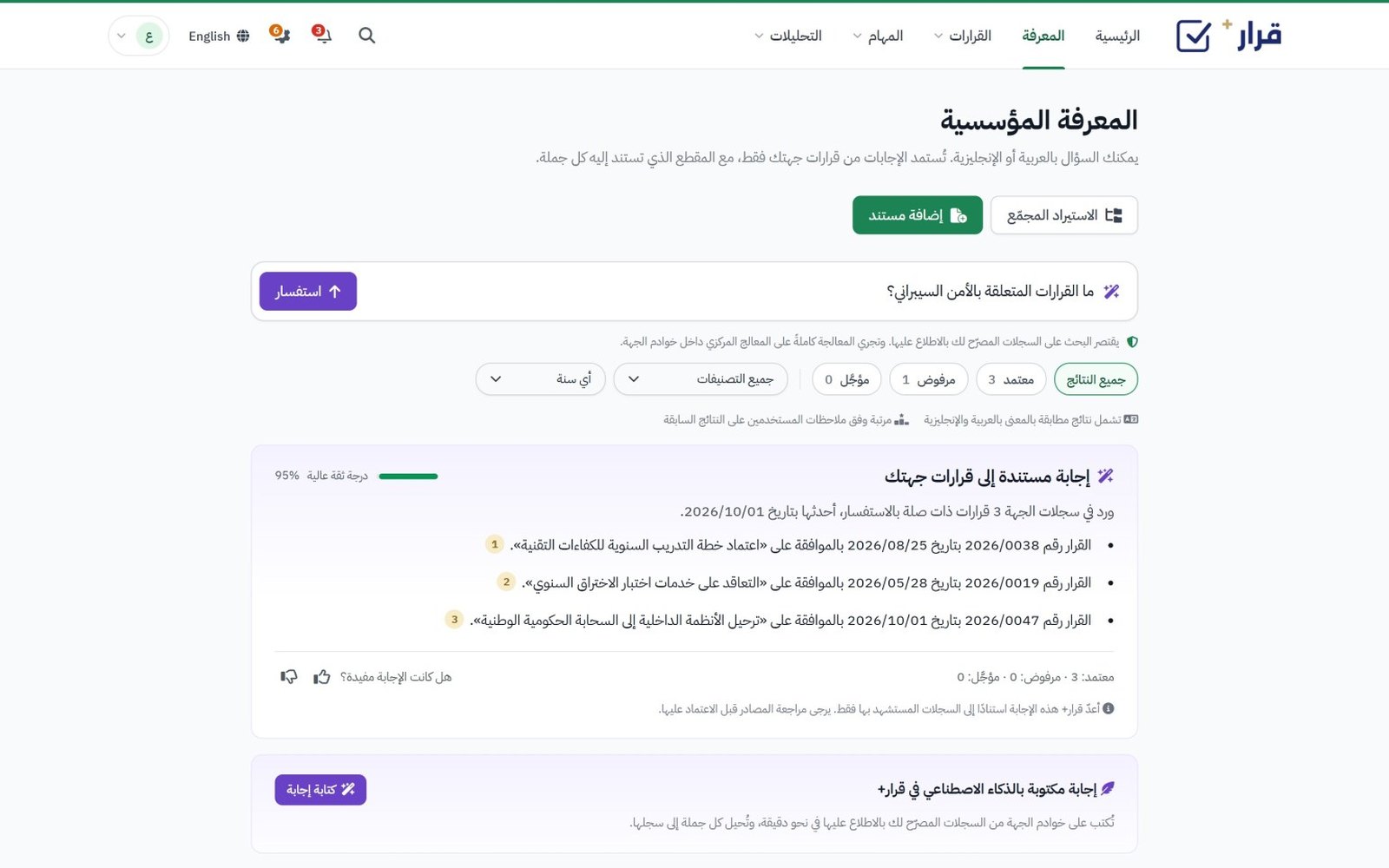
Ask the institution’s memory
A written answer about past decisions, every sentence carrying the decision it came from, and only from records the asker may open.
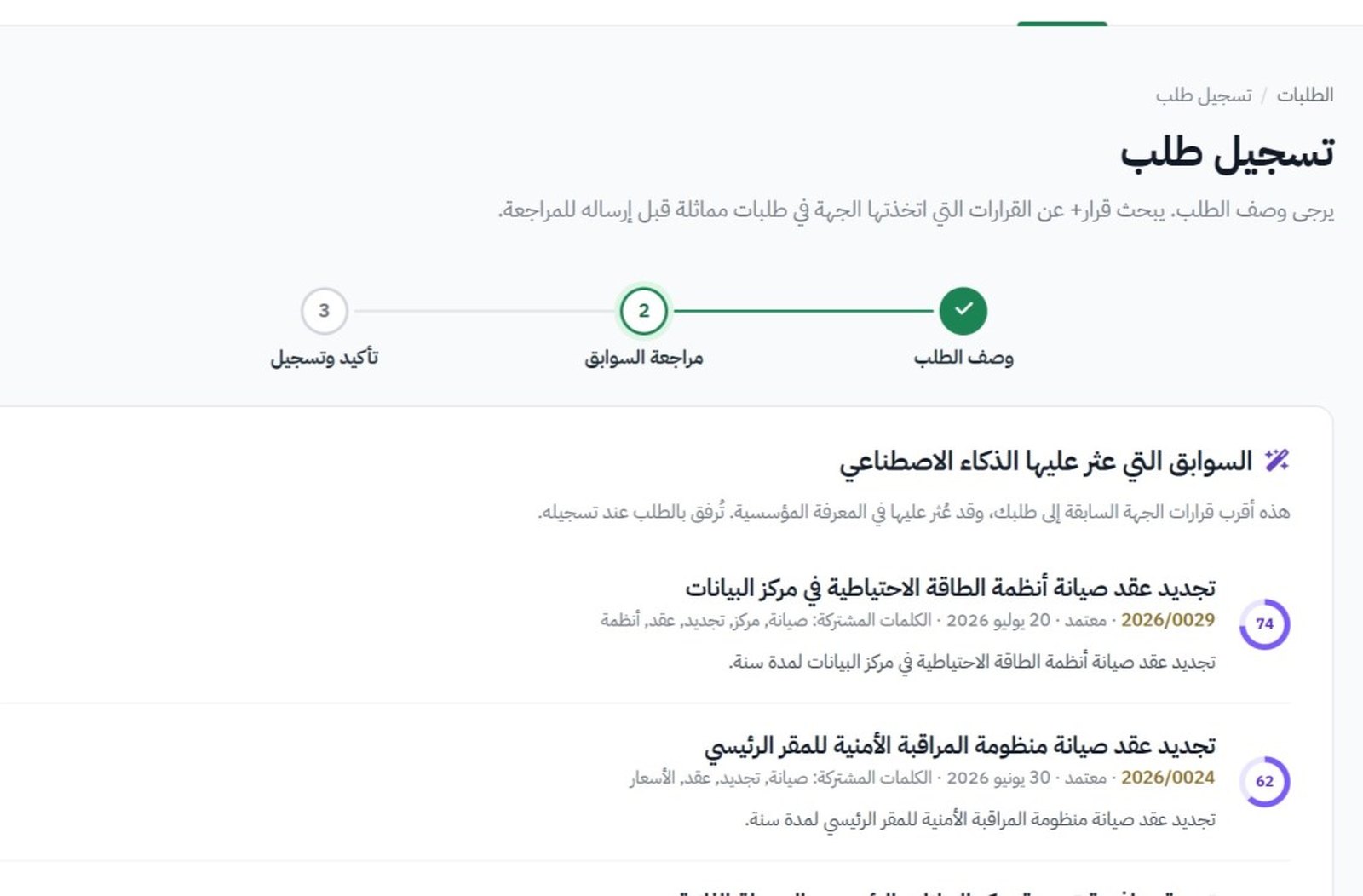
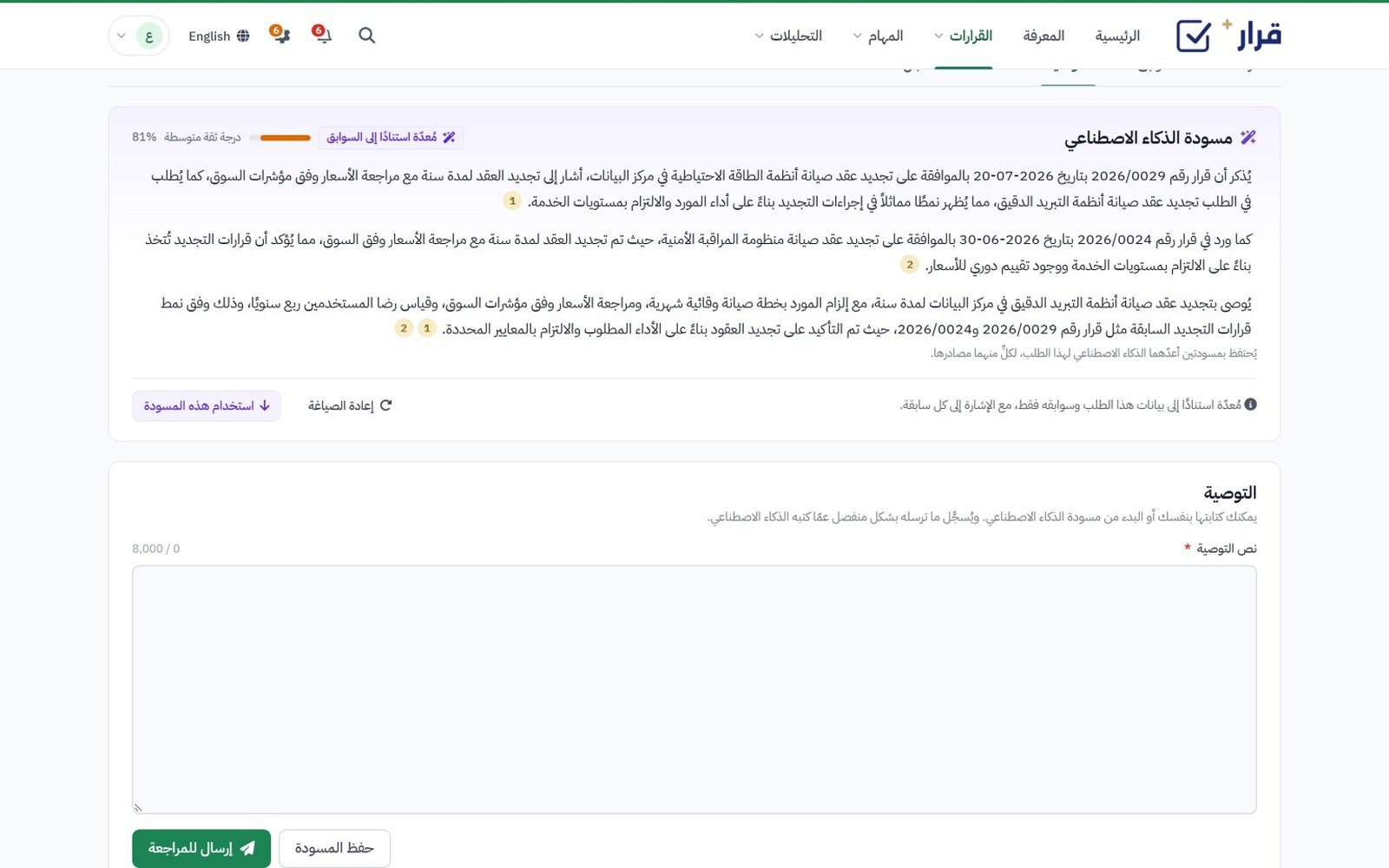
Precedents, found before you write
As the request is described, Qarar+ surfaces the entity’s own past decisions on the same matter and warns of duplicates.
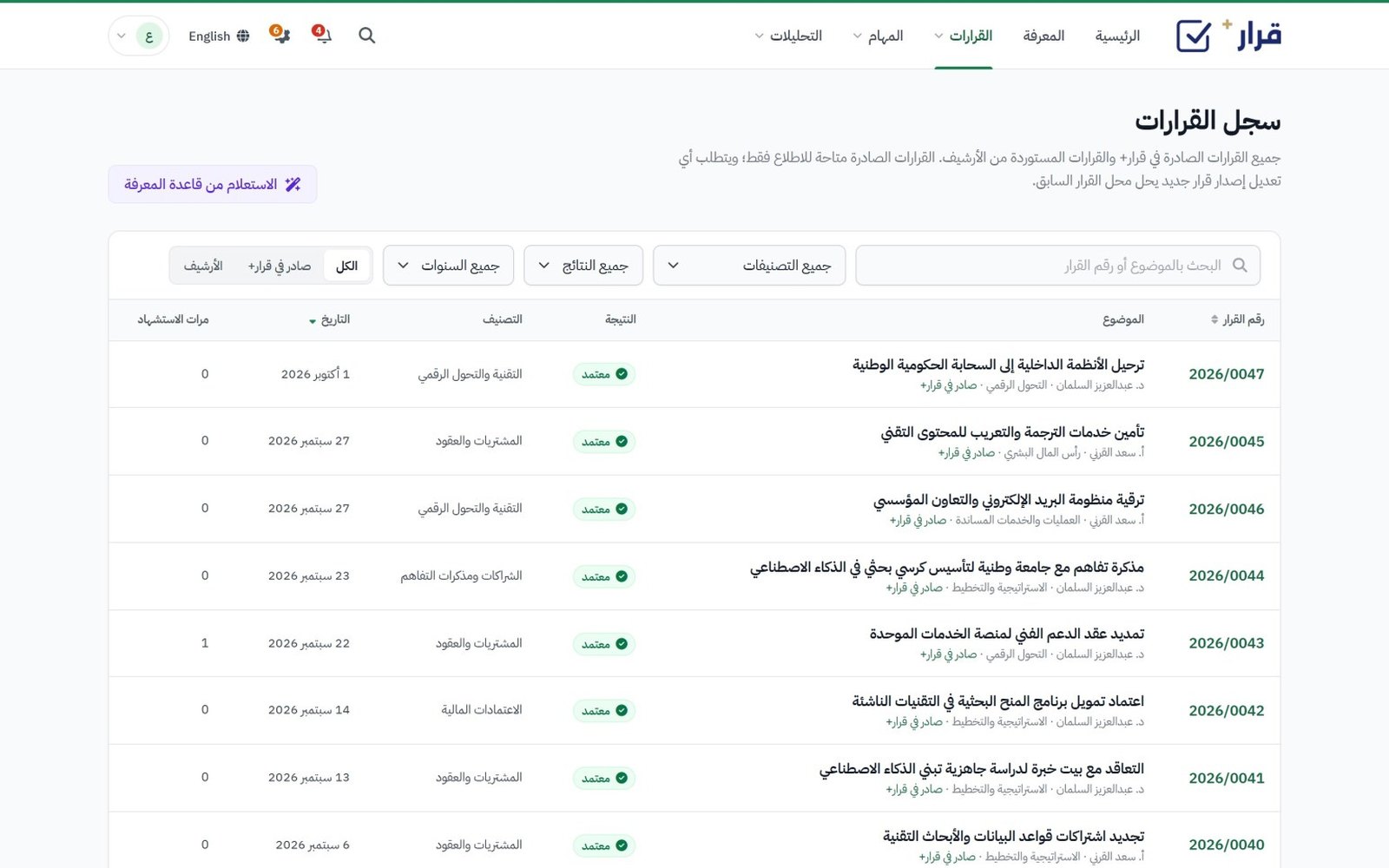
The decisions register
Every decision numbered, dated in Hijri and Gregorian, searchable by subject, classification or number.
A recommendation drafted from precedents
The AI prepares a first draft with numbered sources; the analyst opens any source, edits freely, and decides what is submitted.
The platform
Everything a decision needs — in one place
Four areas follow the decision, from the first request to the day its last task closes.
Decisions and recommendations
4
Register a requestSubject, justification, confidentiality and value, with duplicate detection.
Precedents with sourcesPast decisions and archived documents on the same matter.
Cited draftingA recommendation drafted from precedents, each paragraph referenced.
Decisions registerNumbered, locked and searchable, with Hijri and Gregorian dates.
Approvals and governance
4
Authority matrixThe route and the decision maker chosen by classification and value.
Segregation of dutiesWhoever prepared a recommendation cannot decide it; whoever creates tasks cannot own them.
Automatic escalationA step that waits too long escalates under the entity’s own rules.
DelegationTime-limited delegation of authority, recorded on every step it is used.
Tasks and follow-up
4
Tasks from clausesOwners, due dates and priorities created in one step.
Evidence-based closureThe assigner accepts closure against delivered evidence.
Updates from emailReplies to task emails become progress, with a person confirming the sensitive ones.
Early delay warningsTasks likely to finish late are flagged with their reasons.
Knowledge and insight
4
Institutional knowledgeAsk in Arabic; answers cite the decisions they came from.
Archive importScanned PDFs and Word files read by OCR and confirmed by a person.
Dashboards and reportsTime to decision, where cases wait, tasks by department — exportable to PDF or Excel.
Full audit trailEvery action, including every AI action, with who, when and from where.
Who it is for
Built for entities whose decisions are on the record
Qarar+ suits any body whose decisions must be justified, traceable and followed through — and whose data must stay inside the Kingdom.
Ministries and authoritiesBoards and committeesLarge enterprisesRegulated institutionsMunicipalities and regional bodiesUniversities and research bodies
See Qarar+ on your own decisions
In about thirty minutes we walk your team through one request becoming a decision, and that decision becoming finished work — on your own records.